Welcome to Boulder!

At TechStars, we’ve been getting a lot of meeting requests around “I’m new in town and am looking to get plugged into the startup community”.  In an effort to get you connected quickly and meet the most amount of people, a few of us have gotten together to host a “Welcome To Boulder” event.  It’s just a simple meet and greet with some of the area entrepreneurs who are well connected.

Feel free to join us for the next one!  Check out the invite.

Want to get an inside view into the TechStars program?

This summer, we filmed another season of “The Founders” – they’re 5 minute webisodes that follow 3 companies through the TechStars program.  It’s a great way to get an inside view into what really goes on during the program, and Megan Sweeney does an amazing job filming, producing, and editing the series.

Disclaimer: this is a little shameless self promotion, as you’ll see a lot of me in the videos (and more of me than normal, given I’m still losing that damn baby weight (only 8.8lbs to go!)

But regardless, its a great series.

Check out TechStars’ The Founders Series here!

Privacy and why you should care

I had the priveldge of sitting on a panel yesterday called the Apps Privacy Panel, put on by Silicon Flatirons and the App Developers Alliance.  When I was first asked to sit on the panel, I wasn’t sure what value I could add.  I’m not technical and I don’t follow the field of privacy and data security closely.  But Brad Bernthal said he was looking for someone with an entrepreneur’s perspective, so I agreed.  We were joined by a couple of attorneys including Bryan Cave’s Jason Haislmaier, and most interestingly by Julie Brill of the Federal Trade Commission.  The conversation was more stimulating that I expected.  Intriguing in fact.

Privacy and security are things like – what data are people allowed to collect about us?  What can they do with it?  Who can they share it with or sell it to?  For instance, we’ve all seen the Google ads, when you’re in your Gmail inbox, for products that relate to the topic of an email you’re reading.  Google is using data in your email to display relavant ads to you.  So maybe if you’re pregnant, and you’re talking about it with your friend in an email, Google might display an ad for a crib.  But can Google share info about your pregnancy with others? Can they tie it back to you as an individual?  Can they sell that data to potential employers who might not hire you if they knew you were pregnant?

The landscape of privacy and security is not well regulated YET.  There are mostly just some common sense guidelines to keep us doing the right thing.  But data privacy is a massive concern, so I believe it’s only time before legislation kicks in to regulate it to death.  This is good news/bad news for entrepreneurs.  The good news is that it’s not regulated yet, thus expenses dedicated to following law here are minimal.  Regulation = overhead/infrastructure, and when you’re a startup, you really want to be focusing on your product or service, not on overhead and infrastructure. I think (maybe naively)  if we, as software engineers and companies, can do the right thing with data and privacy, there will be little reason for the government (like the FTC) to step in and regulate it.   So – DO THE RIGHT THING PEOPLE!

The bad news is that b/c it’s not regulated yet, there are a lot of gray areas around what the right thing is – and it only takes one or two bad players to spoil it for everyone.

I won’t rehash the entire panel’s conversation for you, but I thought I’d share a few key takeaways from my perspective.  Here’s generally what I learned to help guide you in making sure you do the right thing.

  • If you’re developing an app or website that is involved with youth, medical, financial, or employment information, or your selling data you collect to a third party, get yourself a good attorney that understands the landscape.  Let them be your guide.  Don’t try to learn it on your own.
  • Better yet, everyone should just talk with an attorney around best practices for data privacy and security.  If you build it into your app early on, it’s much less costly to fix retroactively.
  • Be transparent about what data you’re collecting and what you’re doing with it.
  • Use easy to understand & clear UI/UX practices to effectively communicate to your users what data you’re collecting and what you’re doing with it.  READ – 31 page privacy policies and terms of service agreements don’t count.
  • Ask for permission to collect sensitive information, and protect that sensitive information securely.
  • Honor your data promises to your customers.
  • When it doubt, ask around.  If you’re not sure of the ‘creep factor’ of your app or data collection/storage/usage features, ask around.  If it creeps people out, figure out how to communicate the WOW of your app and take care not to sell that data or use it in ways that would upset your customers.
The FTC put out a decent pamphlet on privacy and data security best practices.  It’s not a one stop shop, but it will get you pointed in the right direction to start thinking about the topic.

Now go code something.


A common funding mistake

A common funding mistake that I see many entrepreneurs make is a lack of communication with their potential investors.  It’s becoming prolific, so I felt inclined to write about it.

If you’re raising capital, and you’ve got a handful of investors who are committed, its imperative that you communicate with them in a frequent and regular manner.  You can talk about progress you’re making in fundraising, growth in the business, any struggles you’re having, and any help you need.  The last 2 are pretty important because they show your investors you’re thinking clearly about your business and will be honest with your investors about the ups AND the downs.  Transparency is key.  Your investors can be your biggest supporters and can help out many ways, but if you don’t keep them in your circle of trust, they won’t help, they might be surprised with things turn south, and they’ll feel misled.  Clearly you should choose your investors well, but if you treat them like the partners they are, you’ll build a business from the same side of the table.  Good investors know how sausage is made.

But I digress.  The message here is to communicate with regularity and frequency.  An email about once a week is the right rhythm (for me anyway).  If you go completely silent on an investor, then 4 weeks later provide wire instructions and signature pages, they might back out.  Here are some of the reasons I’m used to hearing:

  • I found another deal that was more interesting.
  • I didn’t feel a sense of urgency.
  • I felt like the founders were shopping around to get a better offer.
  • When the closing docs came, I asked for an update and the company looked very different then when I committed.
  • What company?  I don’t remember even giving them a commitment

There are probably other reasons too.

This is such an easy problem to fix, it saddens me to see it happen all-to-often.  Here’s your 2 step plan to ensure it doesn’t happen to you.

  1. Communicate with your investors weekly and transparently – ask for help, report progress, identify areas of weakness.
  2. Close your round quickly – no later than about 45 days after the ‘start’ of fundraising.

See, easy.  Now go close your rounds people.

Working mama challenge #533

Wednesday I flew into and out of Chicago for an investor event (Excelerate Demo Day!).  But working mama challenge #533 almost got the better of me.  My alarm went off at 4am so I could catch a 6am flight.  But we still share a family bed, so my son Jackson decided he wasn’t happy that I was getting up.  I couldn’t spend the time to get him back to sleep because I was riding the line of being incredibly late for my flight.   So I had to get my husband up at 4am to help quiet Jackson to keep him from waking the rest of the house (which included my 2 year old daughter Aleka, my 10 week old niece Lyla, and sister & brother-in-laws Katrina & William).

Now I’m running late.  Very late.  I pull into the parking lot at the airport with 45 minutes till departure.  I sprint through the parking lot to the terminal, in heels, while simultaneously digging for my drivers license.  Of course the security line is long, which only serves to add to my anxiety level.  I get stopped at security because I have an ice pack (I’m still nursing Jackson, therefore I’m pumping, and need to carry a cooler with ice pack when I travel).  I’m already frustrated, mostly with myself for running late, but the TSA guy doesn’t help the situation by saying stupid things like ‘where’s the baby?’ (uh, I wouldn’t have to pump if I had the baby with me) and “good thing your ice pack is still frozen or we’d have to take it from you” (really?  I don’t think so – ice packs melt buddy, it happens, and you’d spoil the milk if you took it, and if you had any clue how much pumping sucks, you would never want to mess with a mama and her pumped breast milk for fear of losing life or limb.)

So after a verbal scuffle with the TSA guy, I arrive at the gate basically as they’re closing the doors to the plane.  At least I made it!

But now that I’m on the plane, I really need to pump before I ruin my only shirt.  And I’m trapped between two beverage carts that are taking forever.  So finally, the flight attendant lets me get up but directs me to the front lavatory.  In the rear of the plane, there are two lavatories, so it goes unnoticed if you take a while.  But at the front, there is only a single lavatory.  I sigh, knowing that people will be waiting for it to free up and it takes me a full 15 minutes to pump, 20 if you include prep time and cleanup time.

So there I am, sitting on the toilet on flight #533, 8 minutes into the pumping (and 7 minutes to go still), and the flight attendant begins to bang on the door.  “Are you okay?” he shouts over the hum of the engine.  “Yes” I reply, hoping he’ll leave me alone.  “Can I get you anything?” he presses.  “Nope, I’m fine, thank you.” I return.  I’m thinking please leave me alone now, embarrassed.  “There are people waiting out here” he pounds.  “I need another 5 minutes” I retort.  “Can you hurry it up?” he continues to push.

At this point in the story, you have to understand how I feel.  I’m sleep deprived, groggy, stressed out, and embarrassed.  But now, I’m pissed because he’s not taking the hint and won’t leave me alone.  “Listen”, I yell.  “I’m pumping breast milk.  Okay?  Your stupid beverage carts trapped people in their seats for over an hour, my boobs started to leak, I’m in my only shirt, I’m headed to a big investor meeting, and I HAVE to finish.  Okay?  Tell the guests I’ll be out momentarily or use the other lavatory”.

Silence from the other side of the door.  “Okay” he says meekly.

When I finally finish and exit the lavatory, he’s still standing there.  I blush.  He blushes, the first passenger in line smirks and avoids my eye contact, and the 2nd passenger in line is a woman and high-fives me.

Great.  Can I just go back into the lavatory and hide until everyone is off the plane please?

So I dedicate this posting, Working Mama Challenge #533 to all mamas that have ever had to pump breast milk on an airplane.
How to achieve and maintain Inbox Zero

Working at TechStars comes with voluminous montains of email a day.  On an average day, I get north of 250 emails, most requiring some sort of response.  On a high-volume day (like during applicaiton cycle), I can get as many as 500 emails in one day.

It’s daunting.  And since I pride myself on responsiveness and follow-through, it eats away at me if I can’t respond to everyone.  I’ve been buried in email for the last 2 years, and I’ve tried more methods, software solutions, tricks, processes, etc to solve this problem.   I’ve finally succeeded in getting out and I want to share my method.  Here’s what I do.

  1. Use GMAIL!  Spam filters + labels are incredible.
  2. Use the web browser to read your email, don’t use a client.  It took me about 3 weeks to get to the point where I actually liked working with the native gmail interface, but once I got used to it, now I love it. You cannot beat keyboard shortcuts for speed.
  3. Use the Google Labs feature called “Multiple Inboxes”.  When you configure it, configure it to show ON THE RIGHT.
  4. I show 2 labels as my “multiple inboxes” on the right.  1 is called “do by friday” and the other is called “do sometime”.
  5. As I read my email, I either a) answer it right away.  b) label it “do by friday”  or c) label it “do sometime”
  6. Use Boomerang.
  7. Schedule 1-2 hours each day for nothing but EMAIL.  Block it off on your calendar.  I try to do ~ 1 hour in the morning as soon as I get in, and 1 hour right before I leave.

Alright, now that the basic setup is complete….  here are the tricks.  It’s important that you show the multiple inboxes on the right and filter by those two labels. If the labels are just buried in the label list on the left, or if they’re above or below your normal inbox, you won’t see them.  It’s also imperative that you move stuff out of your inbox as soon as you get it, either by labeling it with one of those two labels, or replying to it right away.  If you can reply to it within 60 seconds, do it right then.  If not, apply one of those two labels.  You should never read an email in your inbox twice.  If its an email you reply to, but need a response  back from, use Boomerang.  It’s a great little service that says “add this message back to my inbox if no one replies in X days”.  So once I hit send, I just boomerang it, then archive it so its out of my inbox.  It will appear back if people don’t follow through.

I also schedule extra time on fridays to empty out my “do by friday” label.

If your email gets tagged “do sometime” – goodluck.  I will respond to it at my earliest, which might be next week or might be next month or in 3 months.  But I will respond.

This method works for me, hope it works for you too!

Canada Day

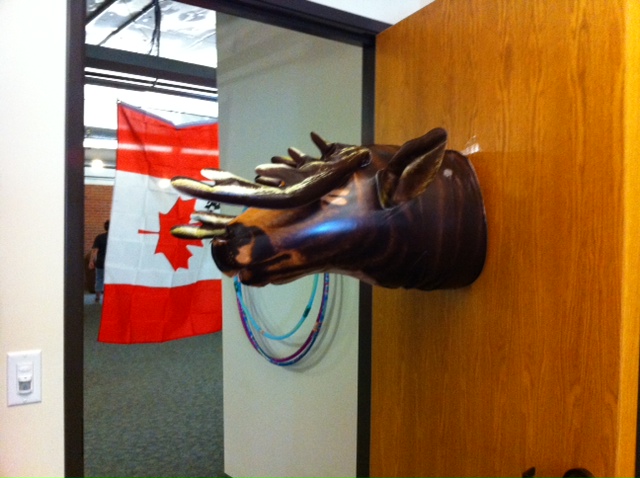
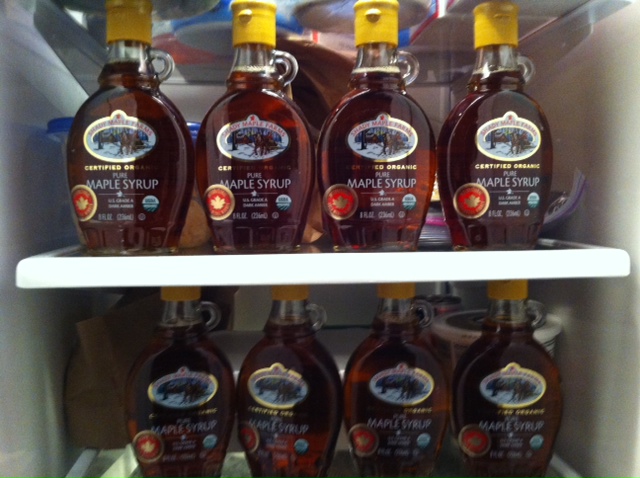
We have a sense of humor here at the TechStars office in Boulder.  Someone, not sure who, decided to remind us that Canada Day, which was Sunday, July 1, is important too! Hmmm, I’m looking at you Ubooly or DealAngel!

By the way, what you can’t see is a Celion Dion song plays every time you open the fridge.  Fantastic prank, and especially loving the moose head on my office door!  Awesome way to start the week.

Today’s #FashionFriday’s outfit

I skipped last week because I was traveling.  But this week, as proof that women only wear 20% of the clothes in their closet, I broke out this little jacket.  Its been in my closet for over 5 years now, and I took the tags off this morning to wear it.  It’s a little snug (cmon, still have 10 lbs to go ’till pre-pregnancy weight), but it does fit.  By the way, I’m also wearing jeans that I wore in college.  Yes.  Those jeans are nearly 20 years old (and I fit in them!  woo hoooo!  and I can breathe!)  .  And yes, that is a cardboard cutout of David Cohen in a leisure suite.

So what do you think?  Keep it?  Or sell it on ClosetGroupie.com?


Hanging at Big Boulder Conference

Today I was lucky enough to moderate a panel called Blogs, Comments, Forums and Rich Social Data Gestures for Big Boulder Conference, an event of epic quality organized by Gnip.  I was joined by Mark O’Sullivan from Vanilla Forums, Mike Preuss from Formspring, Ro Gupta of Disqus, and Martin Remy from Automattic.

One of the great things about being a moderator is that you learn a ton about the topic on which you’re moderating.  I learned a lot about community and the value in giving people various ways to express themselves.  Some people like the long blog format – while others just prefer to comment on blogs.  Forums work for many, where there isn’t one dominant voice, rather a chorus of voices that make up a collective interest area.  Some (like me) focus on the 140 character updates via Twitter.  And some people go for the extremely lightweight interactions such as likes and smiley faces to engage in their comunity.  But regardless of your personal communication style, the platforms that exist today have allowed people with similar interests across massive geographic expanses come together. Mark was telling me about a Koren pop artist forum that likes to create user-generated stories about those pop artists, but that many of the users were in the US.  Martin mentioned that the Turks are some of the most vocal in social media. I learned that a share on Facebook goes about twice as far as a share on Twitter, and that people who login with their Facebook accounts are MUCH less likely to be spammers.  And finally that building a business exclusively on Twitter or Facebook can be extremely dangerous – one new feature rollout could literally kill your company.  And that the social data generated by all these services is massively valuable and monatized by companies like Gnip.

At the end of the day, I realized how lucky I am to be a part of a great community both online here and offline in Boulder.  And it was great to meet my fellow panelists and be a part of Big Boulder Conference.

You can read Gnip’s summary of the talk here.